Technology
How VRFB Technology Works
A vanadium redox flow battery stores energy in the oxidation states of vanadium ions dissolved in sulfuric acid solution. Unlike conventional batteries where active materials are solid and physically degrade with cycling, VRFB active materials exist entirely in solution, giving the system a cycle life that is, in principle, unlimited.
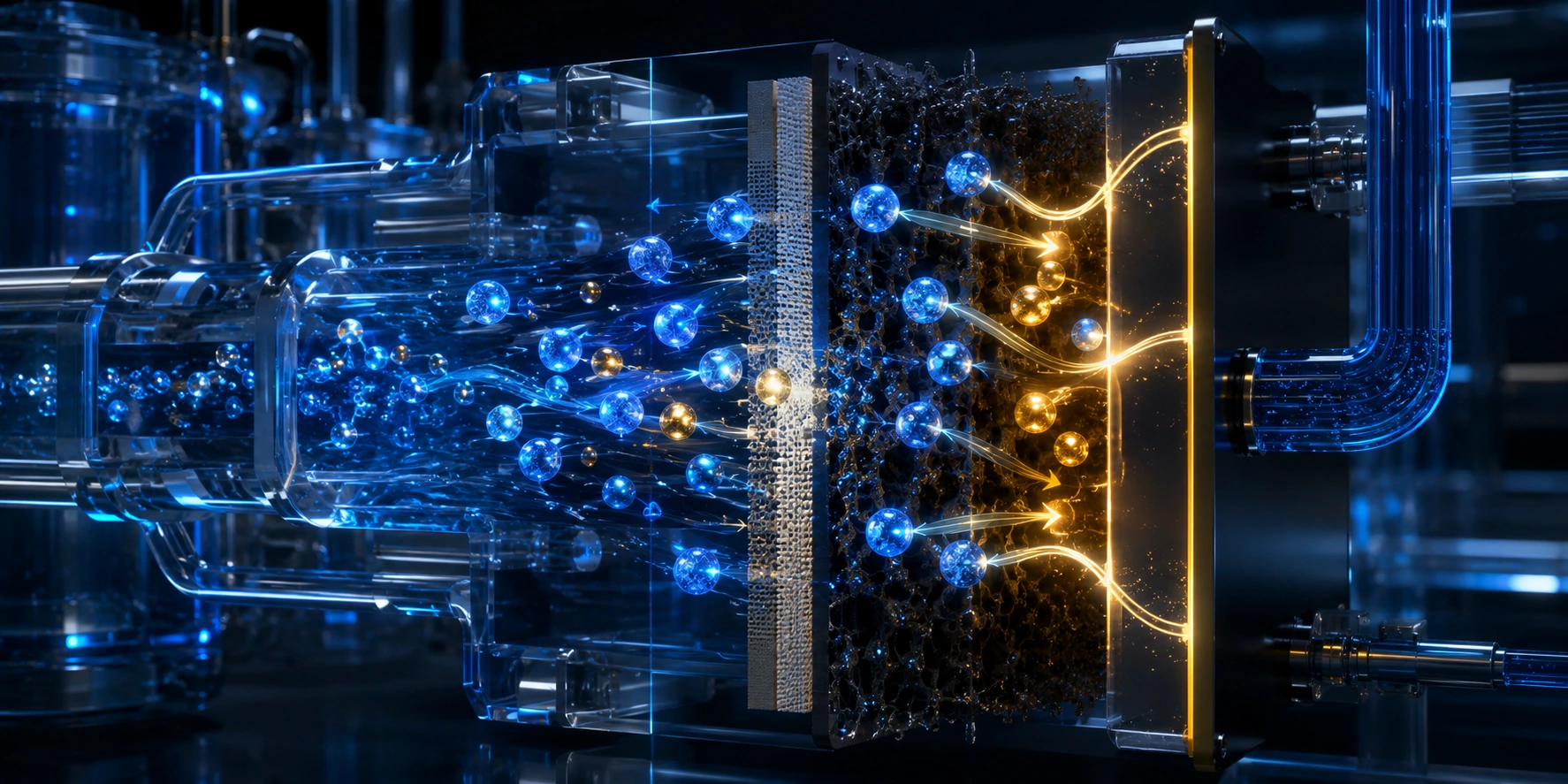
Positive Electrode Reaction
During charge, V4+ loses an electron and becomes V5+. During discharge, V5+ regains that electron and returns to V4+. These reactions occur at the positive electrode, catholyte side, of the electrochemical cell.
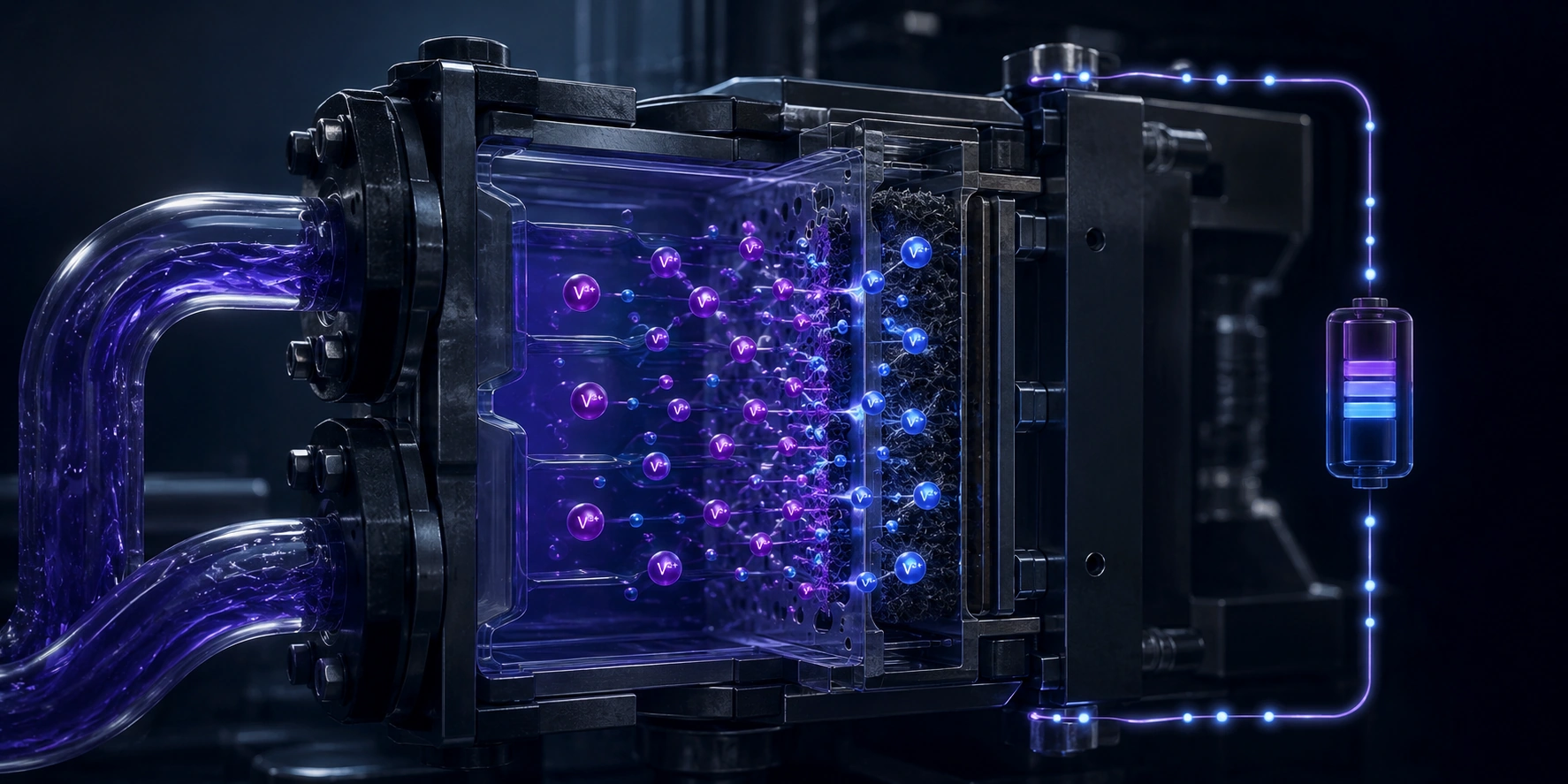
Negative Electrode Reaction
During charge, V3+ gains an electron and becomes V2+. During discharge, V2+ releases that electron and returns to V3+. These reactions occur at the negative electrode, anolyte side.
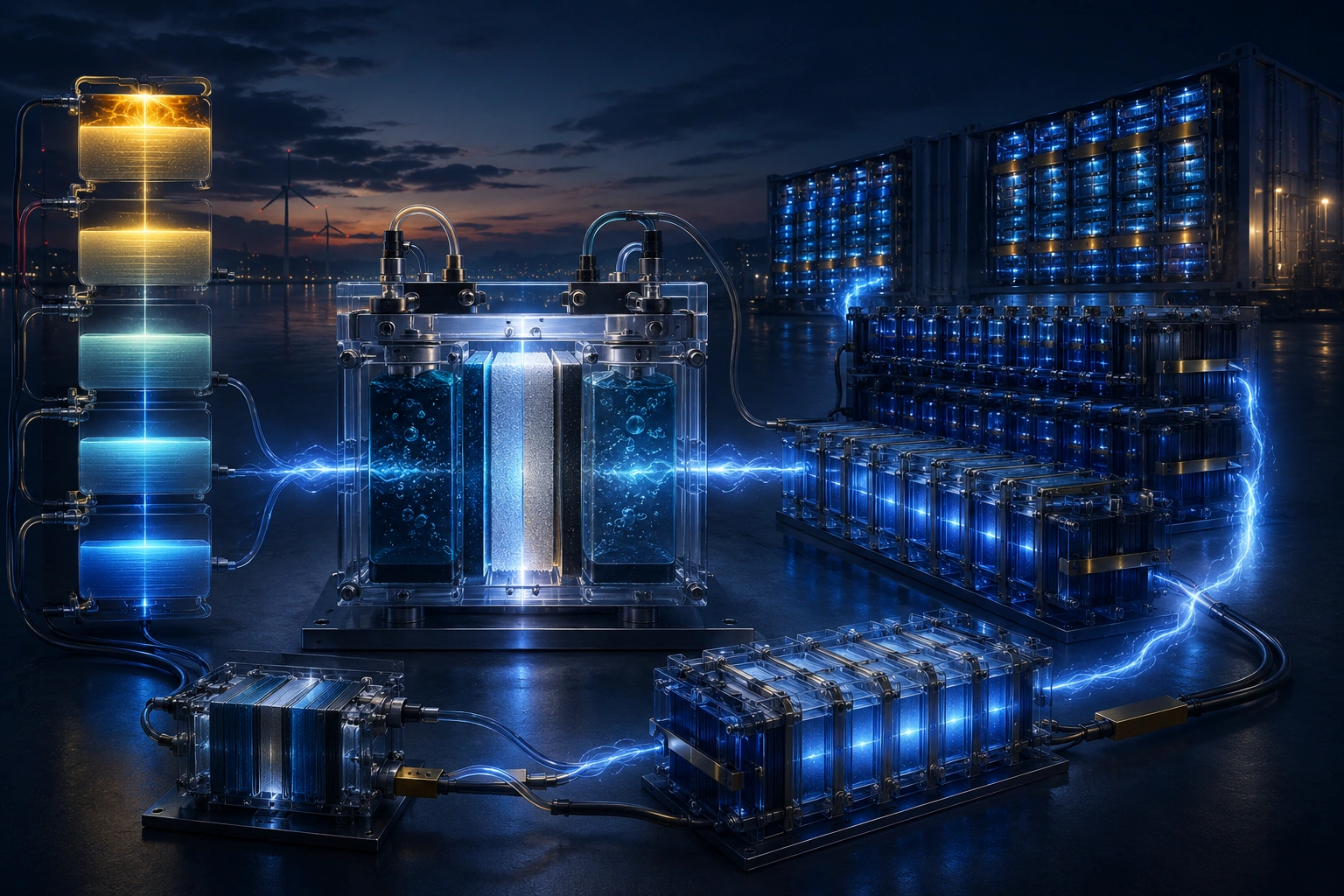
Cell Voltage
Standard open circuit cell voltage: approximately 1.26 V. Operating voltage range per cell: approximately 0.8 V, discharged, to 1.65 V, fully charged. Series connected cell stacks reach practical DC output voltages of 48 V for small systems to 800 V or more for utility scale systems.
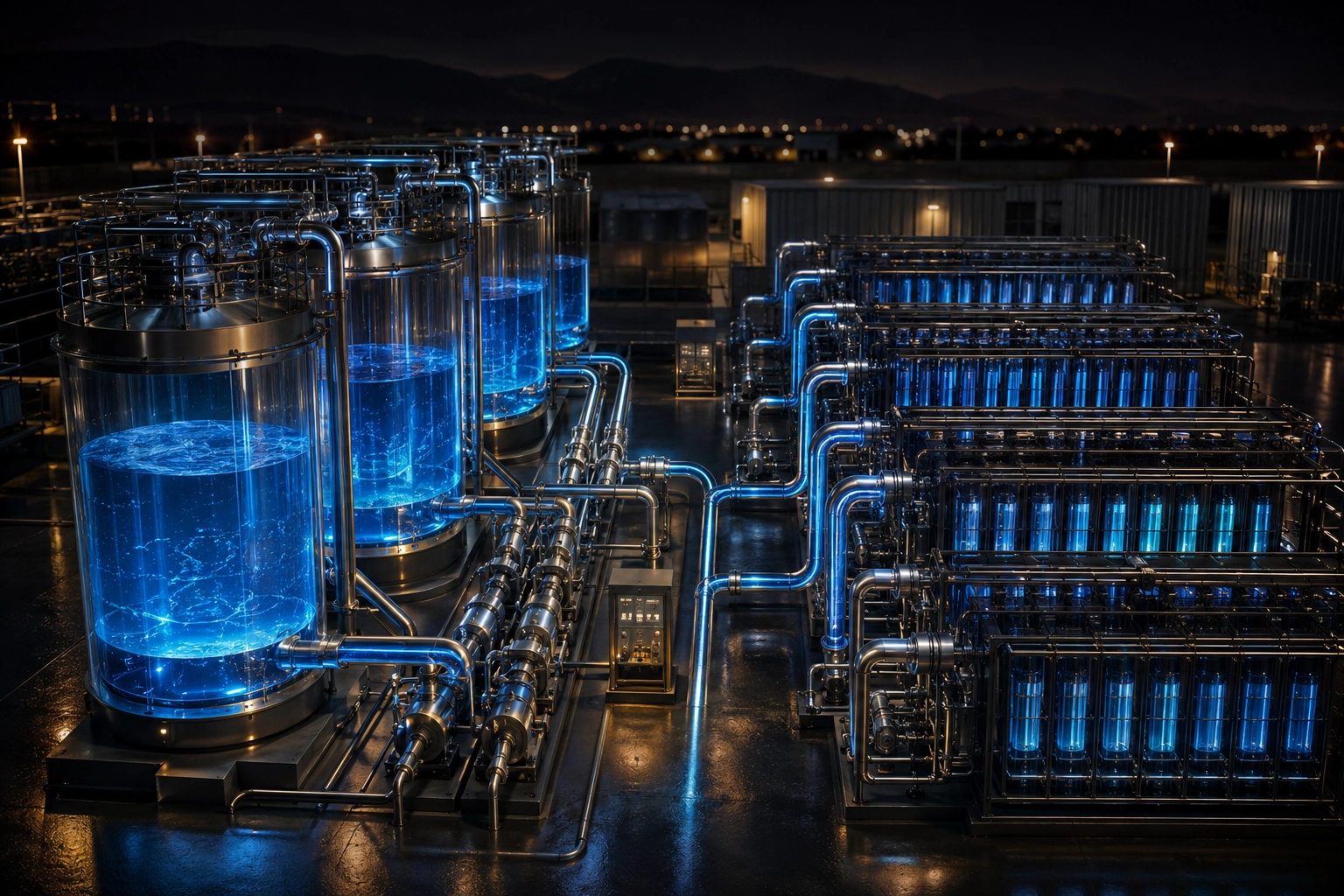
The Critical Engineering Advantage
Energy capacity is determined entirely by electrolyte volume and concentration, add more electrolyte and store more energy. Power is determined entirely by cell stack size, add more cells and increase power output. This physical separation of energy and power scaling is unique to flow battery architecture and is fundamental to the economics of the VanadiumBank leasing model.
Electrolyte Science
Why Vanadium Chemistry Is Uniquely Stable
Vanadium is one of a very small number of elements that forms four stable, distinct oxidation states, V2+, V3+, V4+ and V5+, in aqueous acid solution across an electrochemically accessible voltage window. Using only one active element in both half cells means that crossover through the membrane, which is unavoidable over time, is chemically self healing. Any vanadium that crosses is still vanadium and the system can be electrochemically rebalanced to restore full capacity.
The Role of Sulfuric Acid
Sulfuric acid is the solvent, proton source and conductivity medium for the electrolyte. Concentration is carefully balanced against vanadium concentration: higher acid improves conductivity and low temperature solubility stability, but above approximately 5 M H2SO4, membrane degradation accelerates. VanadiumBank's intended 2 to 3 M vanadium formulation targets 4 to 5 M H2SO4 as the optimal balance.
Temperature Management
Standard commercial electrolyte at 1.6 to 1.8 M vanadium is reliable between 10°C and 40°C. Higher concentrations, 2 to 3 M, have a lower upper precipitation threshold, typically around 35°C without additives. Additive technology can extend this window for warm climate deployments. Cold climate performance can be improved through insulation and, where needed, active heating of the electrolyte tanks.
The Degradation Myth
Vanadium electrolyte does not chemically degrade with cycling. This is widely misunderstood. Capacity loss in VRFB systems over time results from water transport across the membrane causing volume imbalance between the two tanks, from membrane degradation and from parasitic reactions at extreme states of charge. None of these involve irreversible changes to the vanadium chemistry. Periodic rebalancing and membrane replacement restore the system to original performance. This is why electrolyte recovery and redeployment is a viable business model, the asset does not wear out.
Lifecycle Analysis Framework
LCA Approach
VanadiumBank intends to apply lifecycle analysis, LCA, conforming to ISO 14040/14044 to every batch of electrolyte managed under the platform. LCA is conducted at the batch level and covers raw material extraction, refining and chemical processing, electrolyte production, transportation, operational phase energy consumption and recovery and reprocessing.
The Amortization Effect
The defining LCA result for vanadium electrolyte and the environmental case for the leasing model is the amortization of production impact across multiple project lifetimes. A vanadium electrolyte batch deployed across three VRFB projects carries one third the production phase environmental impact per kWh of storage delivered compared to a battery system that is disposed of at end of each project. The longer the electrolyte asset circulates, the lower its embedded carbon per unit of energy stored.
Reporting Compatibility
LCA outputs will be prepared in a format compatible with BREEAM, LEED and Passivhaus material declaration requirements, enabling lessees to include VanadiumBank electrolyte in green building and clean energy certification submissions.
BESS Integration Considerations
VRFB systems integrate into Battery Energy Storage System, BESS, architecture with several specific considerations that project developers should be aware of:
Battery management
VRFB state of charge is measured via electrolyte open circuit voltage, not cell voltage integration as in lithium ion. SCADA and BMS must be configured accordingly.
Power conversion
VRFB inverters require bidirectional AC DC conversion with separate variable frequency drive output for electrolyte pumps. PCS selection should reference suppliers with VRFB specific experience.
Thermal management
Electrolyte temperature must be maintained within operating specification. Passive insulation is typically sufficient in temperate climates. Active heating required below 5°C. Active cooling advised above 35°C for high concentration electrolyte.
Fire suppression
VRFB electrolyte is inherently non flammable. No gas suppression is required for the electrolyte storage area. Standard electrical suppression applies to inverter rooms.
Safety systems required
Secondary containment bund, minimum 110% of tank volume, electrolyte leak detection, hydrogen vent point at the negative tank, hydrogen generated at very high SoC and acid neutralization materials on site.
VanadiumBank Target Electrolyte Specification, Development Stage
Development stage targets only
All specifications listed are development stage targets based on current research and literature review. They do not represent certified production values. Actual production specifications will be established and published when VanadiumBank moves to operational phase.
| Parameter | Target — development stage, not yet certified |
|---|---|
| Vanadium concentration | 2.0 to 3.0 Mol/L |
| Sulfuric acid concentration | 4.0 to 5.0 Mol/L |
| Vanadium purity target | Greater than 99.5% V, ICP OES |
| Iron, Fe, impurity limit | Less than 100 ppm |
| Chromium, Cr, impurity limit | Less than 20 ppm |
| Density at 25°C | 1.35 to 1.45 g/cm³ |
| Viscosity at 25°C | Less than 5.0 mPa·s |
| Initial state of charge | 50% ± 5% |
| Operating temperature range, standard | 10°C to 40°C |
| Operating temperature range, enhanced additive | 0°C to 40°C, under development |
| Compatible electrodes, assessed | Carbon felt, PAN/rayon, graphite felt, graphene modified carbons |
| Compatible membranes, assessed | Nafion 117, Nafion 212, FKE hydrocarbon membranes |
Want to discuss the technical details?
We welcome conversations with researchers, engineers and project developers who want to explore the technical and commercial dimensions of VRFB electrolyte leasing.
Get in Touch